Sunday, March 27, 2011

Performance and Intervention


Frazer Ward's Shifting Ground: Street Art of the 1960s and '70s and Lytle Shaw's The Powers of Removal: Interventions in the Name of the City explore the ideas of the city street, the art that simultaneously encompasses and is encompassed by the street, and the power of the public person.

Frazer Ward begins by giving examples of what a city street is and what it can be used for. Some of these examples are for social conflict and revolution, as a corrupted public sphere, that it belongs to the commodity culture, and that it is a space of human interaction not interrupted by normal regulation. Two groups that he identified, the Protest Culture and the Counterculture, both use the streets as their own, but in very different ways. The Protest Culture was anti-war, anti-Vietnam, and for black power, women's liberation, and gay rights. They used the streets as a public space to explore, express, and challenge these rights. The Counterculture, though somewhat embodied in similar ideas and movements, was more identifiable by hippies and the sex, drugs, and rock and roll culture. They used the streets a stage for performances and ideas. Karen Jones talks about riots and the ideas behind them: what they are, what they do, and how they function. In the definition she gives, "the riot is a logical consequence of the oppressive forces within the capitalist modern and postmodern space" that can be either spontaneous or brought to violence by police brutality, and threatens to disrupt social order. Having said this, it can be assumed that the Protest Culture, maybe somewhat obvious because of its title but nonetheless important to break down and understand, would be the group that would use the streets for riots that Jones describes.

Ward gives us quite detailed descriptions of a few types of street art that emerged from the '60s and '70s, some based on the same ideas that riots are based off of (where there is an obvious overtone of power struggle and social calling), and some that questioned other aspects of society in a "real-time" way. Hi Red Center performed a piece entitled Movement to Promote the Cleanup of the Metropolitan Area (Be Clean!) where the trio dressed in face masks and lab coats and got to work cleaning sidewalks square by square in Tokyo, questioning the government's priority in the appearance of the city and public space, specifically in the street (in preparation for the Tokyo Olympics). This branch of Protest Culture, though non-violent and non-rioting, still made its point and was viewed in the public eye. Ridiculous as it may seem, it no doubt made passersby question their motives and ideas.

VALIE EXPORT used the street as a place of tention between the private and the public, taking the idea of the female figure from cinema and placing movie curtains on her body for people to open and and view/touch her body. Though this does not have much to do with the street besides the fact that she chose it as her location (for its public space and mass audience, it can be assumed), she is questioning the same ideas that Yoko Ono and John Lennon posed in their 1969 film Rape. This idea in question is, again, this unclear line between how public space, like a street, can be used and is seen. Is it public? Is it private? In Rape, we begin to understand just how public one's private life can seem, from being followed on the streets when seemingly nobody else notices you, to being "violently" approached in your own private space (which, up until fairly recently and with modern technology, was not questioned as being anything but private).

VALIE EXPORT, Touch Cinema 1968

Lytle Shaw approaches the idea of the city street in a less "art-based" form than Ward. Though still giving examples of some video pieces and hand crafted cityscapes, Shaw focuses the discussion more on the idea of the stories of the streets rather than what happens on them (maybe more appropriately, what happened on them and how it is constantly changing). Henry James comes back to America after spending two decades abroad, and comments on the changing of New York City; how its buildings cannot be a permanent aspect of the city because as things change around them, they either change physically to "keep up with the times", or their meaning is changed by their changed context. A small neighborhood that may have been home to generations of families may all of a sudden find itself next to 50 story sky scrapers, almost deeming these small homes as a lesser aspect of the city, regardless of their form or function. In fact, it may even be decided that these homes are not good for the capital in that region, and they may be torn down, as was James's old childhood home. This idea of constant movement and change inquires as to the placement and meaning of other aspects within the public realm, such as art (or James's placard). To help define this idea of a public space, Shaw relates public to urbanism, which is not a "neutral or technocratic domain...in...urban planning, but rather the diverse critical discourse produced by" those dealing with many aspects of society and the arts. It is all encompassing and multilayered.

The main examples Shaw uses to discuss his writing all deal with ideas of indirect meaning. James Nares produced Pendulum, a film showing a wrecking ball swinging at different angles. It does not immediately make a direct statement about its destructive qualities, as it is not destroying anything that we can see, but it most definitely implies this power and what it has done, and will do. In the context of Manhattan, the wrecking ball may be seen as the machine that was responsible for much of the demolition and rebuilding around the time, though whether that be positive or negative is up to the viewer.

Still Image from James Nares's Pendulum, 1976


Charles Simonds began making small clay models of different cities, built for fictional miniature people. These cities were constructed in the same view as the city in which he was in at the time of the model's creation, complete with dilapidated buildings and brickwork. It was a performance piece, where people approached him and asked questions and watched, and Simonds speaks of keeping the small city standing for the sake of the little people in it. It seemed to sway some onlookers who commented that everything that can be done should be done if it can save these small people. Whether they realized it or not, those onlookers were involved socially on another level of thought and understanding involving their own environment, for in fact, they are the little people. These small models also bring up other ideas, as they are reminiscent of ancient civilizations, bringing us into the past in a present state of mind. Who is the destroyer of these crumbling places? Are they anonymous? Do we know them? Is this good or bad?

Continuing this connection between this uncertainty of the past and present, Matthew Buckingham creates a film called Muhheakantuck, showing aerial footage up the Hudson River and narrating what had happened at this land before it was the Hudson, when it was still the Muhheakantuck. Though we are hearing this story from Buckingham alone, it is likely to be biased, as all art, and stories, are, but cannot be overlooked for its link to this disappeared Native American population. It forces us to rethink our surface level understanding of the city around us, as absorbed as we are in this level of understanding of the city. We live in the here and now, but we rarely think about what happened on these locations in order for us to be able to live there. Shaw ends by ultimately saying that we are blinded by historical stories that paint a certain, narrow way of viewing the past, in which removal is at the main point of many of these issues with the historical past. We are not seeing it from a more unbiased standpoint of "change", but of destruction and demolition (regardless, some of this change can be quite obviously negative destruction, but Buckingham does make a clear point that what we see in his video is the result of change. This positive/negative aspect of it is in the eye of the beholder. Without this change, Manhattan would not be Manhattan. But is this good? Bad? Indifferent? I feel like Barbara Kruger in her Untitled (Questions), 1991).

This age of riots and rebellion, of public and private, of then and now, seems to all come together on the streets of a city, meshing into one giant explosion of culture, art, experience, movement, and ideas.

Sunday, March 13, 2011

Pacyga, Cahan, and Medium Cool


Chicago in the 1960s and 1970s is approached in a few different ways through Dominic Pacyga's "Chicago", Richard Cahan's writing on Richard Nickel, and the fictional/documentary film Medium Cool.

Dominic Pacyga goes into quite a bit of detail regarding Mayor Richard J. Daley's coming into Chicago Mayoral offie, and a lot of the political upheaval and controversy involving both issues that arose at this time, and what Daley did (or did not do) to help fix these issues. When Daley entered office, the city was just getting back onto its feet after having been brought down by the Great Depression. The Prudential building was opened in 1955, bringing into the city a slight boom of new business and people. Based on this success, more than thirty-six million square feet of office space was opened up in the loop. This change in structure, population, business, and financial state of the city opened up new doors for changing demographics.

Public housing was a huge deal in Chicago starting in the late 1930s, and merging into the '40s. The Chicago Housing Authority created (ultimately) a three stage housing plan to help combat poverty in the city. The first stage went underway with new houses and three to four story flats, complete with courtyards, walking space, and statues. Following this, the second stage took place, as townhouses were quickly put up for returning war veterans. This mass amount of wartime living relocations, both permanent and temporary, led to whites feeling trapped by this ever expanding black ghetto, and blacks being pushed away by whites who didn't want their neighborhoods to be anywhere near each other. Around this gime, almost a quarter million white people moved out of downtown Chicago to either the outer edges of the city, or into the suburbs. A third stage of public housing was then created. This stage, though Daley fought for low-rise public housing, ended up becoming the largest high rise public housing project in the world. This seemingly "obsession" with building these massive structures, left a few questions unanswered, such as how so many units could be filled by tenants who passed the criminal background and adequate income checks. Ultimately, they could not, and in a haste to fill the buildings, the rules were sort of let go, leading to criminal activity, gangs, and violence that erupted out of some of these housing developments (most notoriously, Cabrini Green). These public housing units were also very much overcrowded, as the old slums had been, and for awhile, they were at a standstill in dealing with these pressing issues.

Around the same time, there was a huge push forward in the United States for a reliance on the automobile. The government funded the building of tollways that connected everywhere with a vehicle-accessible road. Chicago was connected to the east coast through a system of highways, and all of the Chicagoland was able to be accessed by private vehicle. However, as we saw before in New York specifically, the building of these massive freeways through a major metropolis poses some huge issues. Whereas in New York the issues were based on some wealthier neighborhoods fighting to keep a highway from cutting across their neighborhood (though I'm sure the issue was brought up in some not so well-to-do neighborhoods as well), no wealthy communities were bulldozed (or in the original plans to be bulldozed). As I read that Daley had fought for a small community church to be saved from highway demolition, I though "Wow, he's completely not like New York's Moses who cares about nothing but how this plan could best work out for him personally. He actually wants to help these communities." But then I read the part where Daley and his wife had gotten married in that church, and the previous thought very quickly floated away (although, he did question the continued splicing of the city, wondering if it was a good thing for Chicago or not). Even though this one, historic church had been saved, the highway didn't spare other community's churches. The Italian neighborhood relocated their church, only to have it torn down again four years later for more construction. The Polish neighborhood was disrupted by the highways, too. This construction was not based on race or skin color, but on the wealth of the communities: no wealthy communities had to fight to keep their churches or buildings standing.

Following the highway boom, the Civil Rights Act became the main political issue. Daley backed this act, but did not enforce decisions made around it, even when Martin Luther King came to Chicago to help change the city's clear cut borders between white and black. He subsequently then lost support from both the black and white populations. The white communities did not want any integration of the black community into their neighborhoods, and, god forbid, into their schools. This brought about many protests, though mostly peaceful, in Chicago. However, when Martin Luther King was shot and killed, violent riots broke out, complete with arsonists and looters. The city was in upheaval.

This emotion that was wiping over the city was then added to by the arrival of the 1968 Democratic National Convention. Protestors staged riots, both peaceful and violent (or turned violent by the use of violence upon them by police) all over the city. It ultimately resulted in the famous riots in Grant Park, as seen in the film Medium Cool. Though this film was part fictional, part documentary, it brought up powerful ideas about the influence of the camera and its use in the public media. Documenting the actual riots, the film crew is not safe from being hit with gas and jostled around. Their footage, though still attempting to continue the scripted storyline, cannot deny the events that occurred: cops beating peaceful protestors and people being dragged down to the ground. It was definitely a wake up call to the world.


This film also has direct relation to issues surrounding photography and media in Chicago now. I can't find the article on it, but I believe it was last summer where Chicago cops had beaten (I believe) a photographer recording an incident between the cops and the bicyclist. There have also been recent arrests of photographers and confiscation of photographic equipment by officers in Chicago, just because a photograph was taken of them or what they were doing while in a public space. These ideas in mind, I am very cautious about what I photograph in public, and seeing this footage of the cameraman standing directly over cops as they beat young adults in 1968 was almost a shocking idea. From what we saw, no officer took a billy club to the cameraman. That would be very different today.

The other article, an excerpt from Richard Cahan's writing on Richard Nickel, did not focus on political or social issues, but that of the actual structures of the city. Nickel, an architectural photographer, was very much focused not on the glorification of these buildings, but their realistic representation. If a building was magnificent for its height, Cahan would emphasize this quality in his image. If the building were crumbling and entering a state of disrepair, which many of his photographs focused on, he would translate these broken beams and dusty bricks into his photographs. More so a documentary photographer than an architectural one, Nickel fought for the restoration of older buildings (rather than their destruction) through his images. He the photographs as symbols of the buildings' stark reality in an attempt to show that these buildings are our history and most public art form of the city. "Nickel wanted to use the camera to teach others to see without a camera", and he used the realistic qualities of the buildings he shot to try to do this.

Sullivan's National Farmer's Bank, Richard Nickel

Garrick Theater, Richard Nickel

Destruction of the Garrick Theater, Richard Nickel

Sunday, March 6, 2011

Los Angeles: 1960s-1970s


This week's materials were composed of a short video by Reyner Banham entitled Reyner Banham Loves Los Angeles, and two readings relating most directly to Edward Ruscha's work in and about LA: Pop L.A.: Art and the City in the 1960s by Cecile Whiting and Ed Ruscha, Pop Art, and Spectatorship in 1960s Los Angeles by Ken Allan.

As an overview, the Banham video was shot in 1972 by BBC, sort of documenting Reyner Banham's excursion through LA and its not so well known "touristy" areas (or, rather, it's well known areas that are not pegged as tourist locations). The entire video is based off of this made-up "Baede-Kar" guidance system, where a horrible automated female voice directs one around the city via cassette tape in the car's tape player. To make the viewing experience more "edgy", Banham decides to boldly ignore some of her recommendations to go to places, such as Malibu, and head to spots that he has pegged "tourist-worthy". A few of these destinations, whether they be Banham's or Baede-Kar's, are simply landmark objects seen in passing from the freeway, such as billboards. Most all shots in this film are taken from the car, where the world can be seen blurring by behind Banham, or out the front windshield. Towards the middle of the film, we are taken on a bus tour, where all landmarks, whether originally intended or not, are seen merely in passing. In the late '60s, early '70s, there was also this huge movement of "van culture". Though there really isn't a solid definition to give to this term as to what exactly it would encompass, it is broadly the idea that people became enthralled with the ideas and versatility that vans could provide. You could paint them, live in them, play piano in them, sell food from them, have sex in them, drive in them...the possibilities are quite endless. They became just as much an art form as they did a practical driving object for which they were created. Cecile Whiting described a piece entitled Back Seat Dodge '38 by Ed Kienholz, which depicts a sexual act between a plaster woman and a chicken wire man in the interior of a rusting vehicle (not a van, but same idea).
Ed Kienholz Back Seat Dodge '38, 1964
Banham also asks some interesting questions about the idea of LA as a city. "Is LA a style or a frame of mind? A sort of mass-produced fantasy for people to live in? Could this city be a mechanism and style to impose on the rest of the world?"

Cécile Whiting goes more in depth with the idea of this infatuation over car culture in the 1960s. Billy Al Bengston created works on canvases using techniques of paint application on motorcycles and cars, asking viewers to relate his paintings to the motorcycle culture he was deeply a part of. Judy Chicago used male and female abstract sexual forms in her painting of a car hood (Car Hood), and was on track with the rest of her male peers in combining sexuality and hot rod culture. Though these ideas, when placed in the '60s and '70s seem sort of, well...super ambitious, or maybe humorous, for something as simple as a car, it's quite ironic that we are still using our cars and vans (okay, vehicles) for the same types of things today. Though not as outwardly prominent as this new idea of hot rod culture was then, a good number of people are still involved in "pimping" their cars today. There are tv shows about it, there are car shows (Chicago's auto show just ended), and there are specialized body shops everywhere that pursue it. Not to mention the number of people who work on their cars in their own driveways. Maybe it's less about flashy paint now, but this idea of creating a car into something other than a mechanism of getting from point A to point B is still valid. People still have sexual encounters in cars. People sell food from cars: ice cream trucks, taco trucks, hot dog trucks. The culture has interwoven itself into the threads of society more seamlessly, but it is definitely still there.

Not dealing with the sexual themes and flashy styles that Bengston and Chicago were, Vija Celmins and Ed Ruscha created work dealing with the automobile as well. Celmins work, specifically here Freeway, explores the idea of this arbitrary moment: driving down the San Diego Freeway. Whiting describes this painting as having "transform[ed] the urban freeway into a landscape with its own unique space and topography while drawing attention to the experience of viewing through a car's windshield." What is curious here, is the use of the word "viewing"; that this is an "experience of viewing", as if this experience was not before noticed before we had freeways such as this one to focus our attention upon. Even Banham states that the freeway is a "complete way of life." Maybe what Whiting did not realize, was that the experience of viewing had been noticed and utilized at least a hundred years prior by a type of people that have been referred to as "flaneurs"; and this is just what the car culture allowed people to become in LA.
Vija Celmins Freeway, 1966
Ruscha, though not quite able to be referred to as a flaneur, was still an observer of sorts. He created a handful of different photo series and paintings, documenting, such as the Bechers began producing in the '80s and '90s, similar items in a almost sickeningly repetitive way. Some Los Angeles Apartments, Twentysix Gasoline Stations, and Every Building on the Sunset Strip are just three examples (and probably his most well known). Through these series, Ruscha, unlike other artist's of the time, was creating a practical way of looking at the city versus making a social commentary about whether it works or does not work.

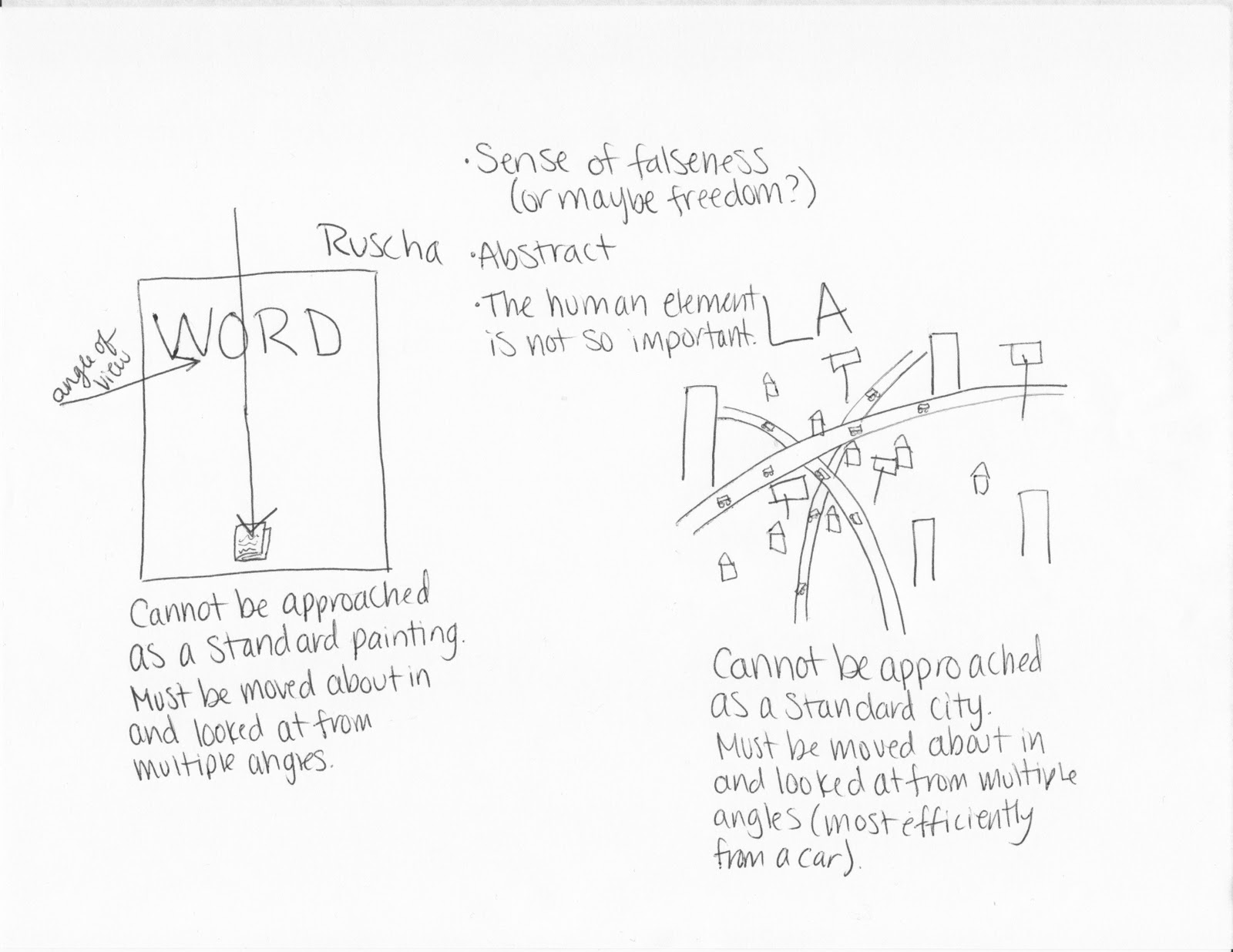
Ken Allan describes Ruscha's work as going against the norm "to conjure up associations with a later era of urban development that would produce an entirely different city in form and experience." The way in which Ruscha photographed was not in the typical photographic way; he did not aesthetically compose his images and was not worried about their beauty or aesthetic qualities as a photograph. He made images. Ruscha's Some Los Angeles Apartments were all photographed very straightforward from street level, sometimes at a slight angle and sometimes straight on. Each image in and of itself did not mean much, but as a whole collaboration between all of the images, it represented a certain style of apartment living with in the LA area. This is LA. Or, rather, this is ink on paper representing what LA looks like. He was very careful to make sure that people were not able to step into the images that he created. Though some of this has to do with composition and the type of splicing he used in his Every Building on the Sunset Strip series (where different cars were spliced together and buildings edges were repeated and cut off at strange points as each image was bumped up against the next), it also has to do with how Ruscha presented his pieces. His paintings, as well as his photographs, were very physical objects. The pages of his book were meant to be handled and be held. They were palpable. He even produced a photograph called Hand Flipping Pages, where it shows hands turning the pages of his book Twentysix Gasoline Stations. In his paintings, he would paint a large word, and then make the viewer step up to the canvas to look at a life-sized image (perhaps a pencil, or a newspaper with writing to be read), where the paint and canvas would be very much a real part of the piece. Sometimes, he would even change the plane of view from the top half of the image to the bottom half, whereas the word on the top would be looked at from an upright position, and the newspaper on the bottom half would be seen as being looked down upon. It seems that his play against the convention of the upright picture frame mimics the way in which LA plays against the convention of the standard city. Ruscha's work "asks us to connect spectatorship, painting, and the spacial experience of the new American urban landscape of the 1960s."

The idea of these photographs as tangible objects and not places, seems in stark contrast to one of Stephen Shore's images:
Stephen Shore Beverly Boulevard and La Brea Avenue, Los Angeles, California, June 21, 1975
As I'm sure you've noticed, this image was taken in LA as well, a little over a decade after Ruscha produced his Gasoline Station work. Not only is this in color, but it is taken at street level by somebody standing on the sidewalk (unlike Ruscha's Every Building on the Sunset Strip, taken by moving picture from his car), and everything seems very...real. It would seem quite simple to walk right onto this image and down into the depth of the vanishing point.

Sunday, February 27, 2011

Public Spaces and Their Uses


Through three readings this week, Douglas Crimp's Action Around the Edges, Martha Rosler's Culture Class: Art, Creativity, Urbanism, and Rosalyn Deutsche's Introduction to Evictions, the idea of public spaces, how they are used, and how art plays a role in this usage was thoroughly examined.

Douglas Crimp's piece went in to great detail in describing his home neighborhood in the mid 1970s, near what is now SoHo, and the ways in which the "abandoned" piers played a role in the atmosphere of the area (abandoned is here used to mean an abandonment of their original purposes). These piers were fairly populated on what seemed to be a regular basis, with people that the general society most likely would have looked down upon, but whom sparked a huge artistic movement that later was ultimately able to incorporate politics and public support of the arts. These piers had their violent times, with rape, murder, and theft; they had their "taboo" times, with drugs and sex and well, prostitution but with seemingly no exchange of anything but sex; and they had their "normal" or creative times, where artists would come down and create works of art (painting, sculpture, installation-like work, photography, performance art) and Crimp, at least, would come down and watch the sun set behind Jersey on the other side of the Hudson. This idea of such a mixed usage of space was then able to translate into other parts of the surrounding neighborhoods. Empty lots and abandoned, half-finished construction projects (which ironically enough were started by inspiration from Jane Jacob's ideas of giving the people what they need, but turned out to be underfunded and abandoned), as well as people's loft apartments and flats, and abandoned industrial buildings (following the industrial crash) became locations for new types of expression. Orgies, apparently, were prominent in truck yards, dance and performance pieces were shown in artists' flats, and an old firehouse was turned into a gay disco club. This was the epitome of Jane Jacobs's ideas: where the residents would use the spaces to their liking and to their disposal (though this is obviously a very raw, very hippie movement, it satisfies the same points as an up and coming neighborhood would). Artist's didn't have spaces to show their work in because their type of work had never been really though of before, so, they created their own spaces and brought their own audience (and drugs of course). From these small private/public "venues", public art sponsorship began to take form. Performance pieces at the piers were documented and photographed and publicized. It was the quintessence of public art. Joan Jonas, whom Crimp quotes, produced a handful of performance work and films, embodying the idea of space and the city in saying "My own thinking and production has focused on issues of space - ways of dislocating it, attenuating it, flattening it, turning it inside out, always attempting to explore it without ever giving to myself or to others the permission to penetrate it." Crimp adds that "The film [Songdelay] also uses these techniques to thwart our desire to know or possess the city beyond our immediate experience of it in the moment of use." Through the use of upside-down film, a telephoto lens, and this weird flattening and distortion of space, Jonas transforms the city into how she wants it to be seen. This style reminds me slightly of some of Barbara Probst's work, such as:


Exposure #39: N.Y.C., 545 8th Avenue, 03.23.06, 1:17 p.m.
Though quite different in several ways, the idea of transforming a space, literally a building top into a photography "studio" as well as the visual distortion of this woman being in the mountains when she is really on a roof top in downtown NYC, shares some of the same ideas of being unable to penetrate this city.
Martha Rosler in her Culture Class, comments not so much on the ideas of what fits into public spaces, but the issues that have arisen culturally and sociologically within a city, and how art has attempted to change and/or fix some of these problems. She begins by stating that art and commerce coexist, and that capitalism drew on a new basis through the art market as gentrification in these cities began to take hold.

For some background context, the cities were built up and populated in a highly industrial time period. When the industrial market began to decline, the reason for people to live in cities (at least for many of the middle and upper class populations) became a mute point and they relocated into the surrounding suburbs and white picket fence neighborhoods. The cities were then left with lower class citizens in their center, and limited commerce, so they needed a way to bring back in those who had left. They began to give tax breaks for companies who based their headquarters in the downtown area, changing cities into a concentration of corporate administration. The French-based group Situationist International had ideas similar to Jane Jacobs at this time, being that these people already living in the city should be able to use what is at their disposal in a free way to better their living standards (versus the government or city coming in and telling them what they could or could not do). This unfortunately did not happen, or at least not fast enough, because city planners and urban developers, still on track to bring in people who had left, flattened many of the housing projects and poorer neighborhoods and sent those living there to subsidized housing complexes just outside the city. Gentrification at this point became prominent, as artists, poets, architects, writers, and others (many were creatives) began to "infiltrate" these poorer areas and rebuild and remodel the buildings. Though this began to happen in the 1970s, we can still see gentrification even in Chicago today, in neighborhoods such as Pilsen, Lincoln Park, Wicker Park, and Lake View. The changes that this brought into the city in regards to the previously mentioned issues, were immediate. The issues of addressing the poor began to change to issues in addressing the artists, and thoughts of revitalization turned to capitalism based off of market research and advertisement. Though political art still had its structure and bias, reminiscent of the renaissance and medieval periods, artists had somewhat of a free-reign in their work for commerce. Taste (not only in art, but all aspects of this new society) was attempted to be marketed as personal and not based off class or social status, but this idea only regrouped classes and created similar problems as before. Ultimately, this stage of "revitalization" turned a worker based city into a capitalist city fit for a very small margin of the social class ladder.

Rosalyn Deutsche, in her introduction to Evictions, gives slight background on her included essays and their roots. The first two sections of the introduction I found to be very wordy, but to not say too much in any sort of influential way. A few main points struck me more than others, such as a city's spacial organizations need to be organic and natural, but that the space is political and therefore cannot be natural, but must be "taken". I understand that this is sort of a quick summary into the rest of her essays in the book, but maybe without having read those, the introduction seems very disjointed and choppy. For example, she mentions that there is this connection between the homeless population and gentrification, which makes perfect sense if people are made to leave their homes because they cannot afford the cost of their increased taxes or the general increase of wealth in the area, but this point, unless I missed something, just sort of dissipated when I was really hoping it would continue (especially after Rosler had brought up gentrification, but had mentioned nothing about the homeless, I was intrigued by Deutsche's point. Maybe I'll have to read the essay to figure it out). Deutsche spoke a bit more on art and it's political roots and how it is created based on these political reactions, etc., but what really interested me was the last section of the introduction. Here, she talks about this idea that feminism would be frowned upon if it were brought forth through the medium of a public art piece in a public space; that people would be disapproving and uninterested. She states that feminist art is crucial to a more democratic public space, though using the idea of feminism is just a filler word here. Basically, public art is voiced in the concealment, rather than the questioning, of power in public art's urban sites. Public art is created usually for political means whose purpose seems to be almost solely influential, rather than enjoyable. Though people will fight that this art is "democratic" because it resides in this "public" space, the work is neither democratic, nor purely public.

The Oxford English Dictionary's definition of the two terms are as follows:

  1. Democracy: social equality/rights without hereditary or arbitrary differences of rank or privilege.
  2. Public: of or relating to the people as a whole; that belongs to, affects, or concerns the community or the nation; not restricted to the private use of a particular person or group.
I am not saying that public art cannot be politically driven, but that if it has political basis, it should be evenly distributed politically. What I mean to say, is that Deutsche's point of feminism is a valid point, that I had actually not thought of before. Something publicly controversial would not be placed in public space (such as thoughts on abortion, or homosexuality). The government, the political realm, decides that it is best to keep people "happy" with that 'abstract sculpture entitled "The Bear at Noon"' which means absolutely nothing that the public is aware of, nor makes a bold statement politically. Here in Chicago, we have something similar: Alexander Calder's "Flamingo", installed at the Chicago Federal Plaza in 1974. I guess it was meant to contrast the black blocky buildings around it, but that is the only meaning to it I could find. It is not intellectually intriguing, nor politically questionable. As far as the government is concerned, it is the perfect public art piece: art for art's sake (again, very similar to the bourgeois ideals of art in the renaissance era). Those that oppose this type of art, are the ones who are creating the politically controversial art, but that is not something that would be seen in the "Parlor"; I guess we'll have to wait for a time when the "Salon des Refusés" of the twenty first century is created for our cities.


*Sorry this is about 2 hours late. This new 'due on Sunday' thing completely threw me off!

Friday, February 18, 2011

Jane Jacobs Chapter 22: The Kind of Problem a City Is


In her introduction to The Death and Life of Great American Cities, Jane Jacobs makes it quite clear that there are problems with cities. Right off, she makes it clear that these problems, be that of housing developments, zoning laws, parks, or basically any other aspect of the city in this sense, are not problematic because it is in their nature to be so; they are problematic because the planners have created them to be so. She shares her experience of visiting the North End of Boston at two different times: the first when it was overrun, crowded, and dilapidated, and the second when it was thriving, busy, and welcoming. In her research of the area, she discovered that the government had not given the neighborhood any money for reconstruction, but that the people in the neighborhood had pooled their money and had changed their living experience within the city. They knocked down walls to create larger apartments, they repainted, and they opened up shops. When Jacobs spoke to a planner about the North End, he shared in the welcoming atmosphere and the joy of walking down the streets as well, but kept coming back to 'This area is a slum. Why are you in the slums? You should get out of there. It has the densest city population. Immigrants are still coming in.'

From this man's conclusion about the area, regardless of personal experience, it is quite clear that had a planner been given funds to go in, gut, and rebuild this neighborhood, it would have completely collapsed. As Jacobs mentions a bit later in the intro, the main complaint in a housing development in East Harlem, NY, was that the planners had put a piece of grass within the development, and "What good is it? They didn't ask us what we wanted." This idea here, that planners and those of a "higher educational status" than the "rest of us" built what they assumed people wanted in a city, is what Jacobs would consider the root of the city's problems.

Chapter 22, appropriately entitled "The Kind of Problem a City Is" seems almost a direct continuation of the introduction. Stemming from the roots of these problems, that planners build whatever they believe ought to be built (usually grass), wherever they believe it ought to be built, Jacobs states that we must first find out what kinds of problems cities pose.

To do so, she creates a metaphor of the ways in which city builders think and the ways in which scientists think. The three stages of this thought development are as follows:
  • The ability to deal with problems of:
  1. simplicity
  2. disorganized complexity
  3. organized complexity
With problems of simplicity, there is usually a very small number of variables (two seemed like the magic number here). These variables directly affect each other, but don't affect much else in the vicinity. All other minimal variables are disregarded.

With problems of disorganized complexity, there can be variables numbering in the millions. Though one variable may not be able to be singled out and analyzed, there are enough variables to take a somewhat accurate average of their actions and interactions. It's simply probability.

With organized complexity, the number of variables falls somewhere in the middle of disorganized complexity and simplicity. There are too many variables to simply calculate out 'if this happens to V1, then this happens to V2...', but not quite enough variables to take an accurate average. And an average is not something that is called for with organized complexity. This type of thought development deals with specifics. Everything is mapped out and analyzed, not only as an individual "organism" but also how each variable interrelates to others, and what factors are influenced by it. This thought process cannot function on probability.

Cities, then, are of an organized complexity. There are many different regions or situations that ultimately can all be interrelated and have impact on one another. Jacobs uses an example of a park, and that how much it is used depends on its location, and the types of people in that location. These types of people are living in this spot because of other factors that may have nothing to do with the park, but in the long run, the usage of the park may depend on these outside factors. Probability of the park's usage in this case would horribly fail. If a planner were to look at a park and see that it is quite populated, and that the surrounding buildings are all 7 floors high on average, he may assume that a park placed in any location with similar building height would flourish in the same way. But perhaps he didn't realize that down the street is a really good school, and behind that is an ice cream parlor, and across the street is a day care center. Maybe he didn't notice that the people in this park were mothers and children, living in the area because of these other "landmarks". Not noticing what Jacobs refers to as "unaverage" clues (which I'll touch on in a second), the planner may place a park in an area with similar housing structures, but the park will not be touched because the people dwelling here are businessmen, leaving at 8am and returning at 6pm, with absolutely no need for a park whatsoever.

That being said, the type of problem must first be identified before action can be taken. Ways in which this might be possible, are:
  1. To think about processes
  2. To work inductively, from particulars to the general
  3. To seek for unaverage clues involving small quantities, which reveal the way larger and more "average' quantities operate
When thinking about processes, one must look at the circumstances and context in which things exist. Simply based on this, things change how they interact with society (such as the park example). Location matters as a part of process, as well. Once processes are understood, the thought pattern may then go to catalysts that cause these processes to happen, and their factors, too. Most ordinary people, that is to say, those who are not planners, usually inherently understand these processes.

By working inductively, one must understand particulars before jumping to conclusions. Immediate generalization leads to absurdities and irrational actions. Citizens also seem to understand this.

Back to the "unaverage" clues. These clues, though small as they may be, tell the true workings of a city; the reasons why a certain store does well in one neighborhood of the city but not in another, or why one street is always busy, but a similar street a few blocks away only sees tumbleweed on its busiest days. These small clues usually lead to a larger understanding about the city, but they do so in small steps of specifics (again, because the city is an of an organized complexity. These unaverage clues are the specifics that cannot be generalized). These clues are indispensable, and when overlooked, as planners will see them as statistically inconsequential, the types of absurdities that cause problems within the city tend to arise. The idea of these clues made me think of the "police boxes" here in Chicago, the cameras with the blue flashing light atop streetlamps. Though non intrusive to daily activity, and potentially overlooked by somebody trying to determine what size housing development might go across the street, they seem to me to tell something about that specific location. If the neighborhood is one where there is not really any crime, it would seem pointless to put one of these cameras up because part of its use is to act as a crime deterrent. However, when I see one, a little bell goes off telling me to be more cautious of my surroundings; there is a reason that camera was placed at this intersection.

To continue with the subject matter of planners misunderstanding a city, Jacobs refers back to her introduction regarding the Garden City and the Radiant City. Planners were using the Garden City in relation to the simple though process. They were seeing two or so variables, such as population and number of jobs, and using that as a basis to plan an entire society. Obviously there are more variables that affect how a society thrives, but in this utopia, this was all that seemed to matter. As for the Radiant City, a thought process more related to disorganized complexity was taken up, although this isn't too far off from what this "perfect" city would actually be. Because of the style of housing, the understanding of this city's workings would largely be based off of averages of population. Probability would be more acceptable here. Though this doesn't seem like such a big deal, considering 1) that these types of cities in no means took off and dominated the world and 2) they were organized with the idea that they were to be perfect and flawless, so other factors are irrelevant (where in reality they would be relevant). There was sort of a Stepford Wives ideal set upon these Garden and Radiant Cities, and everything was perfect and nothing goes wrong and everybody is happy. It really didn't matter too much that these ideals were unrealistic for the planning of an unrealistic type of city. However. Larger problems began to take place when large city planners looked toward these Utopian city plans for legitimate "advice". Large scale cities, of organized complexity, began to base their planning off of disorganized complexity or even simplicity. Population and housing became a probability numbers game, then was used to determine maybe one or two other variables, breaking down the city into groupings that it did not actually support. It is impossible to create a successful large scale city based off of anything but organized complexity. There are simply too many variables constantly changing at indeterminable times based off of interrelations that cannot be seen from the surface.

Planners would see the city, people walking in crooked lines on sidewalks (though never colliding with anybody or anything, and always making it to their destinations), as disorganized and broken, and install narrow passages for people to walk a straight line, thinking they have fixed it. Planners see disorder where there is simply an order that is not their own. That is the problem in the city.

A solution, it seems, would be to do what the people of the North End did and the people of Greenwich Village did in Robert Fishman's Revolt of the Urbs: Rober Moses and His Critics: choose the way you want to live in your space and act on it.

Friday, February 11, 2011

The Exploration of Street Photography In America


Jane Livingston's piece The New York School Photographs 1936-1963, describes the rise of the group of sixteen individuals that made up the New York School. These photographers created this school based on the style of breaking the photographic rules, but with disregard to the fact that they were breaking them, or that these rules even existed. Many of the photographs that came to be from this group had the feeling of photojournalism, but could not exactly be categorized as such. There was a fleetingness in the work, a sense of disregard to the fine details and perfection of cropping. It transcended both commercial and journalistic styles of photography, and perhaps the best way to categorize it would be to say that it took the complete opposite standpoint of the f64 club on the west coast. Large format cameras were replaced with 35mm hand helds, super fine film grain was replaced with experimental forms of 35mm, a formal control over lighting was replaced with an almost carelessness of lens flare and blowouts. It was artistic rebellion at its finest.

In New York in the 1930s, art, commerce, and politics began to intermingle. Artists began to believe that their art might be able to be used for some purpose other than for their own enjoyment, and started to create art for social means. Photography was especially apparent in this "social welfare" movement, as it could show real people in real situations in real life that others may never see or experience in their lives. Taxes began to subsidize the arts, and while many were okay with this distribution of funding, battles against this continuous support for the arts drew some separation between the general public and the artists, and the "personal artists" and the reformers. Because of this idea that the "artists" were not worth funding and that they were somewhat seen as not doing successful things to benefit day to day society, many of the reform artists refused the title of "artist" at all.

To once again encourage the arts, magazines began to come into print primarily for the purpose of showing images. These photographic magazines would not only publish photographers work, but they would also hire out photographers to shoot for them. During this time, Magnum was also founded. Though scarcely, museum galleries began to exhibit some photographs, though for quite a long time, no "all-photo" gallery existed, as photographs were made more for the purpose of books rather than wall hangings. The types of photographs being created at this time, at least the "serious" types of photographs, and especially at the New York School (NYS), were greatly inspired from films of the time. These films were ones of corruption in high places and vulnerability of the little man, which was quickly soaked up by the NYS. There was also much European influence over photographic movements in the '30s. The sixteen of the NYS were a mix of US natives, emigres, and NYC natives, and all were familiar with the cubism, surrealism, and constructivism movements. Aside from surrealism, most of these photographers were against these movements and created a base in their work with which they could shed the roots of those widespread ideas. Some of the photographers dabbled in surrealism, but ultimately turned to an "approach [residing] in an engagement with the ordinary world."

Helen Levitt was one of the sixteen at the NYS and was greatly influenced by Henrie Cartier-Bresson. Levitt never joined any artistic or philosophic movements of the time, and was pegged as more of an independent photographer and film-maker. She took her own style, and although she did have some photographs displayed in MoMA, she refused a Vogue job because she disagreed with the type of commercial/fashion shooting they were asking her to do. Her book "A Way of Seeing" was comprised of photographs that were made to feel like a story of sorts, similar to that of Cartier-Bresson's work. Levitt was not socially driven to photograph in the streets of New York, but she was aesthetically driven, and photographed for the beauty of the image (and in doing so, also caught much humor in the streets of New York, similar to the type of humor seen in excerpts from Lewis Mumford's The City).


Robert Frank took on a slightly different style than Levitt. Whereas Levitt seemed a bit more "easy going", Frank spent a good deal of time in Europe with friends who were also involved in the art world. They would display work in the same exhibitions, and spoke about sculpture, painting, and other art in correlation to photography. His book "The Americans" gave the 'okay' to break all the rules, as he jumped on the bandwagon of 35mm film and available light photographs. His methods were those of trial and error, and he experimented with film and lenses to create what is now known as his "style". His work is anticlimactic and not particularly cautious of framing or fine detail. His style and work was formed around the emerging styles of the time, and he ultimately helped to create this style as well.


William Klein took an even further step from Levitt, and actually tried to do the opposite of Cartier-Bressson by being "there" and "visible" (while Cartier-Bresson was known more as the "invisible camera"). Klein had no qualms with working for Vogue and shooting commercially for them, while at the same time working on his own work. Here, "his own work" is meant in the most literal of terms. Klein's book "New York" was photographed by him, designed by him, laid out by him, and the typography and editing was done by his hand as well. He saw it cheating that others would be allowed to edit down, order, write about, and title one's images. He is known for very imperfect printing and composition, and strove to include as much information in a frame as possible (his standard lens was a 28mm). Klein was in many ways similar to Frank. Both inhabited vanguard painting and sculpture groups, both used photographs to transcend traditions in photography, both created an original body of photographs, both became filmmakers, both made largely known books, and both spoke of photography with an avant-garde style.

Friday, February 4, 2011

Poe to Benjamin to Gleber: The Flaneur


Edgar Allen Poe begins the "discussion" between these three writers by describing a gaslight era flaneur in his "Man of the Crowd". Walter Benjamin, citing some of Poe's descriptions, continues this timeline of flanerie through the electric light era, and Anke Gleber brings the flaneur into the modern era, placing these previous ideas, as well as some new ones, into the modern city life.

Poe's subtitle to this story is "Ce grand malheur, de ne pouvoir etre seul", or "The great misfortune of being unable to be alone" and he begins his short story with a description of the types of people he sees pass before him on the street as he sits inside a coffee shop in London (which would be the people who would most likely fit into his subtitle). Each type of person, the noblemen, clerks, upper clerks, pick-pockets, gamblers, women, and the "grunge of the city" (drunkards, beggars, etc.), carries with themselves a certain gait and exterior impression upon others, and each type of person interacts differently with those around them. It appeared to me, at first, that Poe here was the flaneur, sitting by idly, watching people pass with a vague interest in their appearance and character. However, as he spots one man that quite fully catches his attention, the roles are switched as if in a relay, and this elderly man becomes the story's flaneur. As Poe follows the man, he observes him in immense detail, down to attempting to distinguish the type of fabric his shirt is made of, and what sort of look sits below this man's furrowed brow. At no time does Poe make himself known to the man, so his observation is one of an uninterrupted and genuine nature. This man's composition drastically changes over the course of the night's hours. He is frail and uninterested when he finds himself alone. When he comes across a square, a busy street, or a bazaar, however, the man finds some inner youth and rushes forth. He wanders the crowd until it breaks, then continues on his journey aimlessly, once again expressing his age through his posture and gait. He enters a shop in the bazaar and gazes hollowly at and through objects inside the shop, certainly not looking to purchase anything, but simply grabbing small details and vaguely observing. Ultimately, we can see that this man is not alone when he is with people, regardless of his interaction with them, and he has no business but that of escaping from his own loneliness. This very basic definition of a flaneur gives Benjamin a running start into his addition to the term.

Walter Benjamin in his "The Flaneur" is the first to mention the actual word flaneur. The dictionary definition is as follows: an idler or lounger; one who strolls about aimlessly. This activity was not one that was in any means known until the birth of the arcades in Paris, France. These interior exteriors provided a place for people to actually walk without having to worry about being run over by carriages and other street vehicles. Their main purpose was not only to provide a place of ambulation, but to provide people with places to ambulate. The "walls" of these arcades were built of store fronts and shops, places for people to go into, move about, purchase items, and continue their stroll through the arcade. And stroll they did. Around 1840, some would walk turtles down these arcades to set their walking pace.

The first issues of this new concept of watching people pass by you as they watch you pass by them, was that this had never been done before. People didn't watch each other in public spaces (as there were no buses or subways or transportation of that sort), and Benjamin speaks that the ability to hear but not see would trump the ability to see but not hear, for looking is the awkward part, and by people burning their pupils into you they might perhaps glimpse your dark secrets. People were skeptic of being in public around strangers who may glance their way, so some Feuilleton physiologies began making claims that one could distinguish everyone they pass in a city just by their appearance. That artists would be identifiable, as would businessmen, and geniuses. This, for a short time, perhaps, kept some people's fears of public at bay, but soon enough, ideas of detectives and mysteries of the city became the hot topic in literature. The popularized idea was that somebody would disappear into the throngs of people by the hand of someone who could be described as "unknown to all others and thus does not have to blush in front of anyone", neither of which to be seen again, but that some average person would become detective and pick up on some small clue and solve the mystery. The people most likely to "come across these clues" would be the flaneurs, as they are the observers of the street, wandering aimlessly and recording details of passerbys' faces and visual forms of the crowds. As these detectives, it seemed that the idea of what would become street photography was born: "He develops forms of reaction that are in keeping with the pace of a big city. He catches things in flight; this enables him to dream that he is like an artist. Balzac claims that artistry as such is tied to a quick grasp."
 Garry Winogrand "Flip"
 Garry Winogrand "Los Angeles 1964"

Ultimately, street lamps were the answer to the feeling of safety within a city at night. These gaslights allowed people to stroll the streets when they otherwise would not be able to, and to look in shop windows by the light of the streetlamps. Baudelaire commented on Brussels that there are no shops and that the streets are unusable to the stroller because of this. The same point is made in "The Social Life of Small Urban Spaces" by William H. White:

whyte styles from chris woebken on Vimeo.
Storefronts are a mandatory aspect of a city to function properly in the flow of crowds. With the draw of more people to the streets, more shops began to open, and this "commodity idea" arose, with people going to and fro, observing the items and their pricetags, and moving about the objects. This new movement throughout stores gave a new sort of "location" for flaneurs, and their observations expanded. Though they were, in a way, part of the crowd, being that they are humans in a specific location, flaneurs are also people who are abandoned in the crowd. They mingle about, picking up pieces that other have left behind. I have a quote from Benjamin's reading, but am unsure that I am interpreting it correctly, so here goes:
Empathy is the nature of the intoxication to which the flaneur abandons himself in the crowd.
This seems to me to be describing flaneurs as having been once in the crowd, and realizing its monotony and sameness, and therefore breaking from this crowd as an individual, empathizing with what they once were, but enthralled with how they see the world as a flaneur. There is quite a long quote by Friedrich Engels on pages 57-58 of the Benjamin reading, so I will not quote it, but to sum it up, Engels describes how people move about with disregard toward others and an air of ignorance regarding everything but themselves and their destinations. They do not realize that everybody around them is also a human being, regardless of race, class, or appearance, and they become trapped in this tunnel vision flow of the city's movement. The more that someone sees themselves as just another in a crowd, the less interest they take in feeling anything toward others. Flaneurs, however, are still vaguely interested in the crowds around them, and at least acknowledge that there is not a drawn out path to take, but will be affected by external elements that they really don't have control over, but will accept with interest. They understand that enjoyment of a society is far greater and more rewarding than enjoyment in a society. This idea of a flaneur's freedom seems metaphorical of A Christmas Carol, where day to day life passes by and people go on their way walking through streets and buying things and going home, and repeating this pattern continuously until they, well, die. But Scrooge is then given the opportunity to observe these patterns and watch, with the freedom of movement and ideas, how these events may play out. As an outsider not fully involved in the activities before him, his senses are able to pick up more than they were able to as a participant, particularly the visual sense.

Anke Gleber speaks highly of the visual stimulus, quoting Benjamin's reading regarding the choice for comfortability of hearing over sight, but laying out just how visually based a city is. Her running definition of a flaneur seems to shift a bit over these twenty or so pages in her "The City of Modernity". At first, Gleber pegs a flaneur as "disinterested, yet highly visually invested in the perception of the style of others", as well as an outsider, an observer, someone devoid of class, indifferent, free to move, perceptive to stimuli and associations, and one who gives attention to details and images. There are two other types of social characters in modernity as well:
  1. eccentricity and sophistication that can be aligned to a dandy's exterior habits.
  2. blase urbanity; snob.
So as the snobs and eccentric and sophisticated people go about their business with their noses in the air and their eyes inward instead of forward and outward, the flaneurs drink in the visual stimulants that create the city around them. However, as the reading presses forward, Gleber seems to mesh "the crowd" and flaneurs into one large glob of people. She makes it clear that as time and technology move forward, and electric lighting comes in to play, that the city becomes more and more visual, until it is all about optical stimuli for this "modern city survival". I disagree. Maybe as posters (public, accessible art) was coming in to play and expanding was the crowd more aware visually of their surroundings, but I believe that in general, especially after time and in this modern city, people have come to ignore these things as well. Sure there are always slight visual attractions that may draw some of the crowd from their beaten path, but in general, people can still map out their route to the number of steps they take, and end up passing the same people every day, though they do not know this because they do not actually see these people. The distinction between who was a flaneur and who was not became very blurred in the last half of Gleber's writing (or I guess, what a flaneur was in this modern urban space).

With railroads creating live cinema out their windows for those inside, Gleber "argues" that people are then more attuned to details and to watching the world around them. But as she says this, she compares this real life movement outside to a cinema, which is nothing more than artificial reality and not a step further from the "crowd's" daily routine. The fleeting details beyond the windows are essentially the same as the fleeting faces of passersby. The flaneur's however are basking in photographs and drinking in the detail that they can capture. Cinema is not of interest to them so much as still images are, with the frozen piece of world created for the purpose of looking, for scopophilia. Gleber then claims that flaneurs devote specific attention to certain detail, but it had been stated earlier that flaneurs do not specify their attention. They have no path and no goal, and do not narrow down their observations. The distinction I finally made between the crowd and the flaneur in Gleber's reading was comparable to a part in the movie WALL-E, whereas WALL-E would be the flaneur, and the location and other people (and maybe machines/robots as well) as the crowd. The "city" is full of visual stimuli, but people become enthralled in what only applies to them. Their paths are predetermined and they move with a logical flow of traffic. Go on green, stop on red. Do not collide. WALL-E breaks through this flow of traffic and freely goes where he wishes and is even intrigued by some of the people around him: